

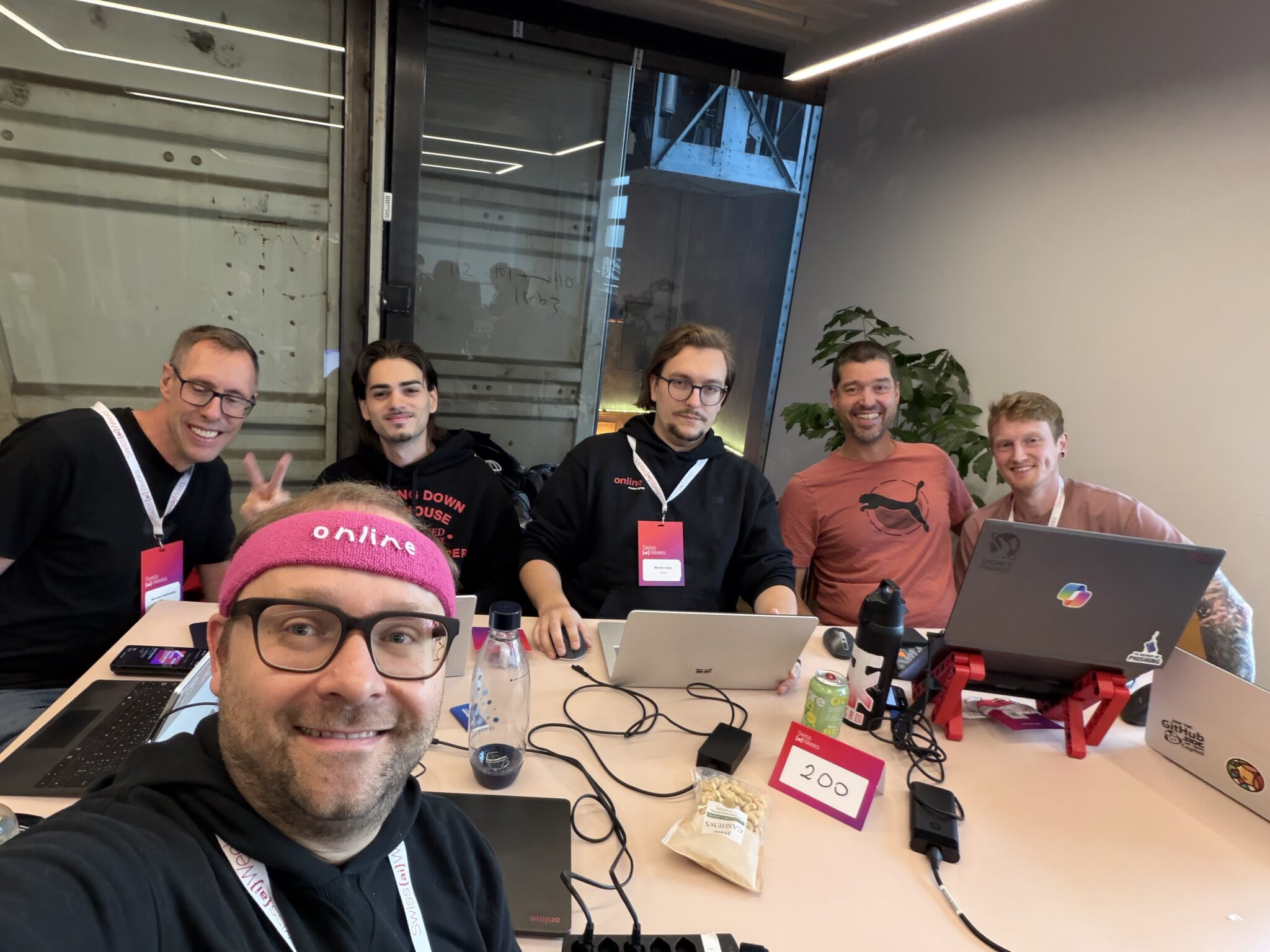
Two days filled with AI, ideas, and teamwork
Today and tomorrow at the Zurich Hackathon, part of Swiss “ {ai} ” Weeks, participants will be developing, testing, and discussing ideas—and probably discarding a few along the way.
A team from the Online Group is also participating. Michael Kammerer, Ralf Angermann, Berat Koxha, Michal Cislo, Martin Ewald, and Reto Oswald are tackling a challenging project together that centers on Agentic AI, digital payments, and the question of how much autonomy we want to grant artificial intelligence.
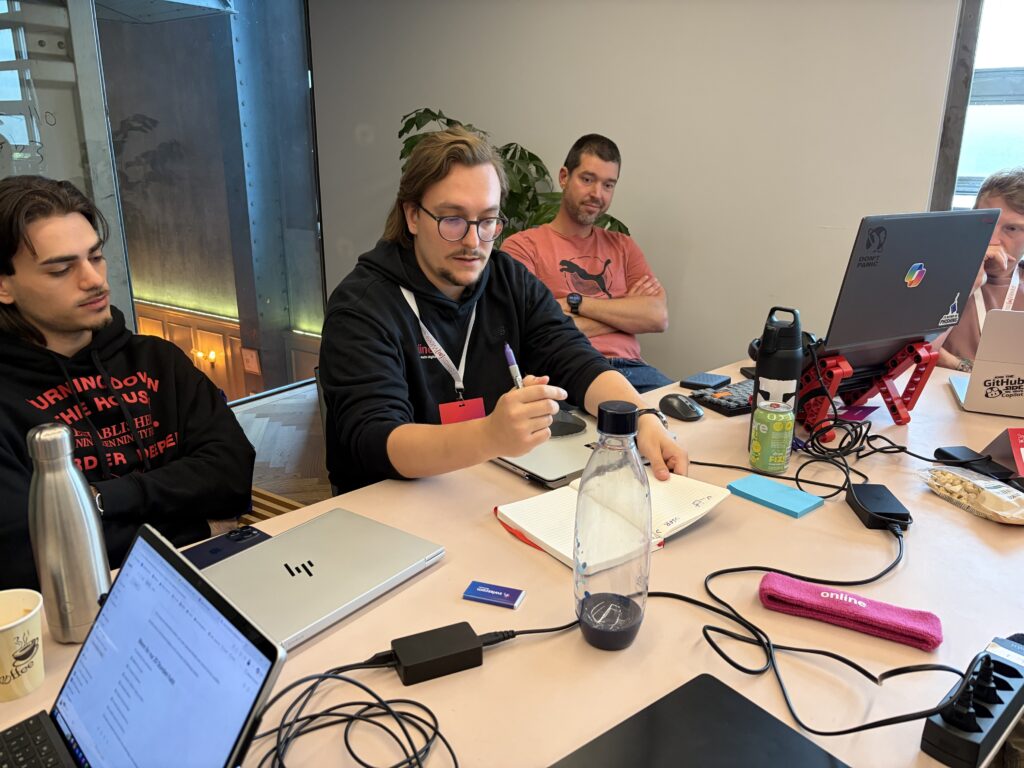
An AI agent, a credit card, and clear boundaries
Our team chose the Viseca Challenge “Agent on a Leash.”
At first glance, the scenario sounds simple: An AI shopping agent is tasked with buying black running shoes for a maximum of CHF 200. It researches suitable products, selects a retailer, and aims to complete the purchase on its own.
But this is precisely where the crucial questions arise.
How does the system know whether the agent is actually buying what the user intended? How can we prevent defined spending limits from being exceeded? How does the system handle unknown or questionable retailers? And what happens if manipulated content attempts to influence the agent’s behavior through prompt injection?
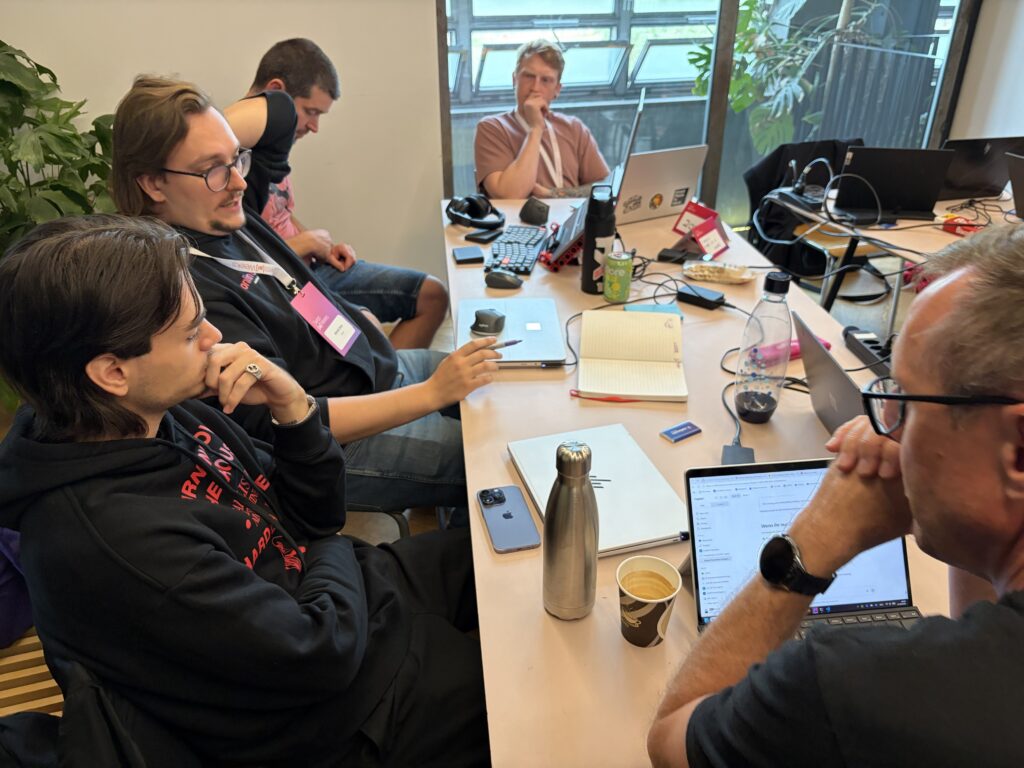
The Trust & Control Layer Decides
Our team’s task is not to develop the shopping agent itself.
Rather, the focus is on the control mechanism between the agent and the payment. A so-called Trust & Control Layer reviews every proposed transaction and decides how to handle it.
A transaction can be approved. It can be rejected. Or the system can ask the customer for confirmation again.
This creates an additional layer of security that combines the AI agent’s autonomy with clearly defined rules, security mechanisms, and human oversight.
Autonomy Requires Trust
This is precisely one of the central challenges of Agentic AI.
The more independently AI systems take on tasks, the more important it becomes to define the boundaries within which they are allowed to operate. This is not about restricting autonomy in principle. Rather, it requires mechanisms that clearly define what an agent is allowed to decide on its own and when a human must step in.
Trust isn’t built solely through high-performing models. It also stems from transparency, clear rules, and the ability to take targeted action when uncertainty arises.
A challenge that aligns with our expertise
The task at hand brings together numerous topics that we focus on intensively at the Online Group.
These include agentic AI, intelligent automation, modern software architectures, security, and the integration of AI into real-world business processes.
Especially with agent-based solutions, it’s not enough for a model to simply function technically. What matters most is how reliably it’s embedded into existing systems and processes, how permissions and rules are implemented, and how security and user-friendliness can be combined.
Our team brings together diverse perspectives and experiences to achieve this. It is precisely this combination of AI, technology, architecture, security, and business acumen that is needed when an idea needs to be turned into a working prototype in a short amount of time.
Develop, test, discard, and improve
A hackathon also means making decisions in a very short amount of time.
Ideas must be critically evaluated, architectures designed, code written, and assumptions tested. Not every approach works right away. But that’s precisely what makes this format so valuable.
Experiment, learn, improve, and work together to arrive at a solution that ultimately not only works technically but also addresses a real-world problem.
Part of the Swiss {ai} Weeks
The Zurich Hackathon takes place as part of Swiss {ai} Weeks.
The initiative brings together developers, companies, startups, researchers, public institutions, and those interested in AI from all over Switzerland. The focus is on exchange, practical collaboration, and a joint exploration of how AI can be used responsibly and effectively.
For us, the hackathon offers more than just an opportunity to contribute our expertise. It also creates a space to try out new approaches, share knowledge, and work together with other participants on specific challenges.
Good luck, Team Online
Michael, Ralf, Berat, Michal, Martin, and Reto now have two intense days ahead of them.
We hope you have fun developing and experimenting, have exciting discussions, come up with great ideas, and, of course, do well in the challenge.
And maybe there’ll even be some time to sleep in between.
We’re excited to see what you’ll make of “Agent on a Leash.”